

SymbioTech: Building Skills for Digital Industrial Symbiosis Across Europe
Europe is moving fast toward a circular economy, and industries of all sizes are under pressure to use resources better, cut waste, and work together in smarter ways.
Industrial Symbiosis (IS) — where one company’s waste becomes another company’s resource — is a proven approach. But in most countries, IS is still difficult to scale. Companies lack partners, data, tools, and people who know how to make it work in practice.
SymbioTech was created to close this gap. The project develops new training programmes for a future role in European industry: the SymbioTech Manager — a professional who can combine technical insight, digital tools, and cooperation skills to drive Industrial Symbiosis forward.

Why the Project Matters
Across 11 partner countries, the picture is similar: companies want to reduce costs and environmental impact, but struggle with unclear regulations, weak digital infrastructure, and limited knowledge about symbiotic cooperation.
At the same time, new digital technologies — AI, machine learning, blockchain, sensors, digital product passports — can remove many of the barriers that slow down IS today. SymbioTech aims to bring these technologies into practical use through education and training.
What the Project Will Deliver
SymbioTech focuses on three main outcomes:
1. Training pathways for HEIs and VET providers
Two complete learning routes — one for universities (EQF 6) and one for vocational/continuing education (EQF 5). Each pathway includes seven modules, covering the full competence range of topics, required for Digital Industrial Symbiosis, such as:
- Industrial Symbiosis Framework
- Life Cycle Assessment (LCA)
- Inter-organisational Relations
- Artificial Intelligence & Machine Learning
- Blockchain Technologies
- Symbiotic Energy Efficiency Models
- Environmental Management Systems (EMS)
The modules are designed to be practical, digital, and directly applicable in company settings.
2. A new competence profile
Research across Europe shows the need for a role that sits between technology, sustainability, and business development. The SymbioTech Manager is meant to fill this space — someone who can understand resource flows, work with digital tools, and bring companies together.
3. Stronger cooperation between education and industry
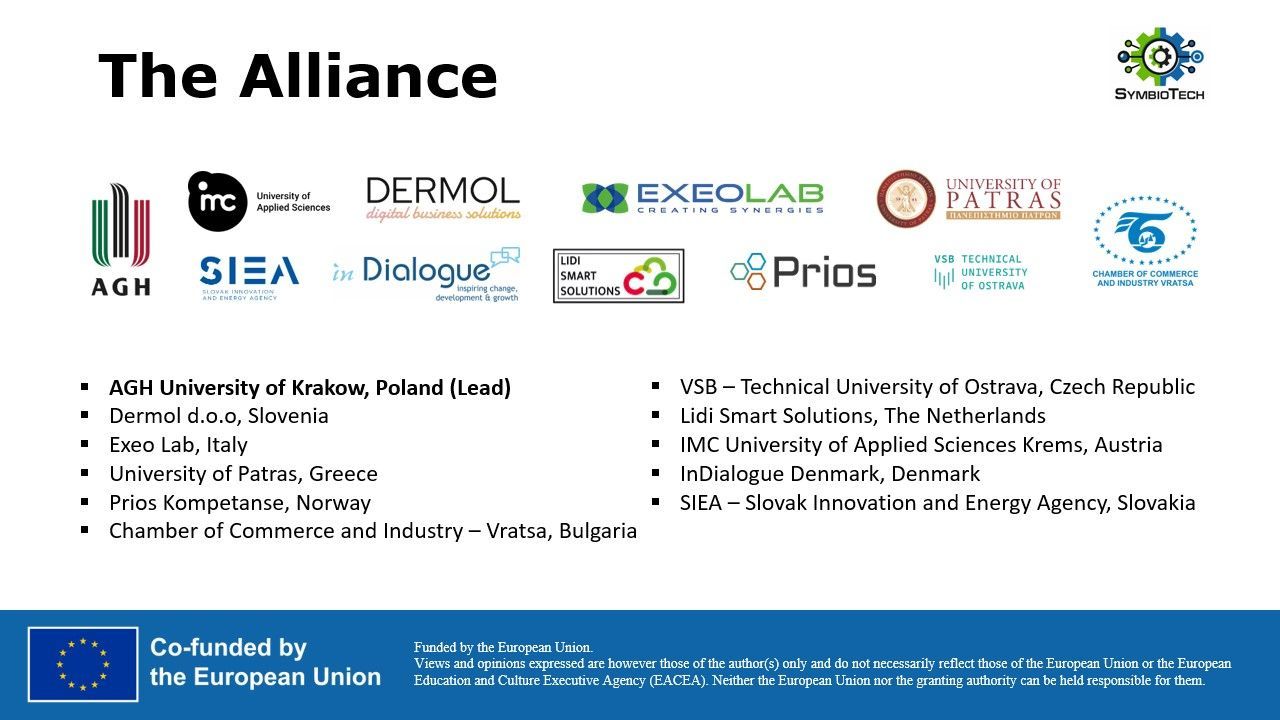
The partners include 11 universities, VET providers, SMEs, research institutes, and business support organisations from across Europe. The consortium is set up to ensure the training is useful in real industrial settings, not only in classrooms.
Higher Education Institutions
- AGH University of Krakow (Poland – Coordinator)
- University of Patras (UPATRAS) (Greece)
- VSB – Technical University of Ostrava (Czech Republic)
- IMC University of Applied Sciences Krems (Austria)
VET Providers
- Prios Kompetanse AS (Norway)
- Chamber of Commerce and Industry Vratsa (Bulgaria)
- In Dialogue Denmark (Denmark)
Labour Market Actors / Industry Partners
- Dermol Svetovanje d.o.o. (Slovenia)
- Exeo Lab Srl (Italy)
- Lidi Smart Solutions (Netherlands)
National Public Body
- Slovak Innovation and Energy Agency (SIEA) (Slovakia)
Each group brings a different type of expertise — academic research, vocational training, digital innovation, business development, and energy policy — allowing the project to combine education, industry practice, and technological development in a single coordinated effort.
WP2 Completed: A Clear Picture of Training Needs
Work Package 2 — the training needs mapping — is now finalised. The partners carried out interviews, surveys, and focus groups with companies, educators, and experts across Europe.
The result is a clear understanding of:
- Where the skills gaps are
- What kind of training companies actually need
- How digital technologies can support IS in practice
This work is the foundation for the training materials now being developed.
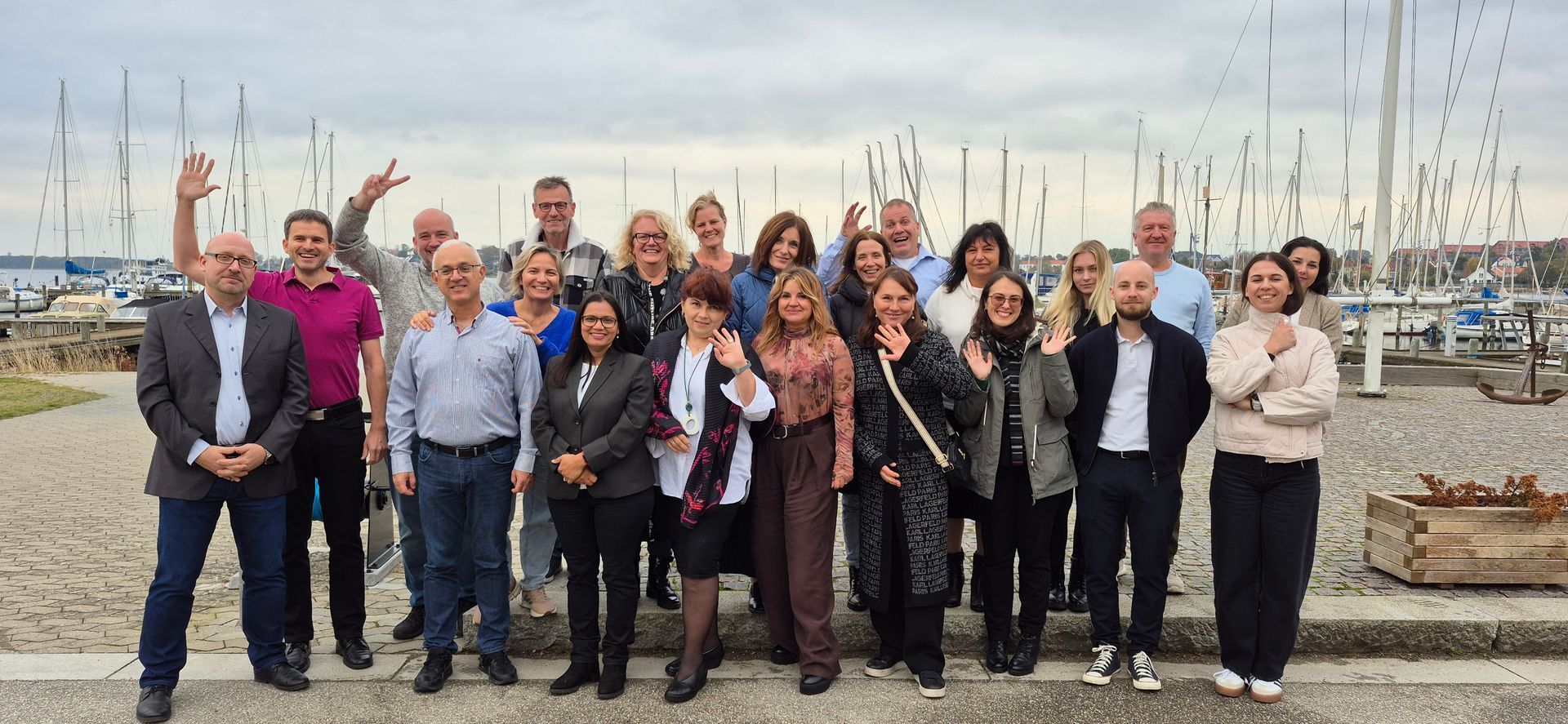
Roskilde Meeting: Planning the Next Steps
In September 2025, the partners met in Roskilde, Denmark. The meeting focused on reviewing WP2 results and agreeing on the next phase - prepare teaching materials, digital tools, and assessment methods — and to test them with learners and companies. The aim is simple: create training that helps European SMEs work more resource-efficiently, more digitally, and more collaboratively.
SymbioTech is not only building a training programme. It is preparing the ground for a more connected and circular industrial landscape across Europe.